![[personal profile]](https://www.dreamwidth.org/img/silk/identity/user.png) hauntedblossom
hauntedblossomThe world of Aureus comprises 4 major continents and various islands around the oceans, with some of these islands being independent while some belong to other regions farther away. Regions are functionally the same as Countries on Earth, with smaller areas in these Regions called "Sub-Regions". These 4 continents are as follows:
Efisga, Avrupa, Mizuho, and Ransei, with the Ransei continent being shrouded in mystery in modern times.
Additional Information
(Click to expand each section)
Solar System:
Aureus orbits around a G-type Main Sequence Star as the 3rd planet from its host star, with 2 moons orbiting it. The star system overall consists of 6 total planetary bodies, with 3 rocky bodies in the inner system, 2 gas giants, and 1 ice giant in the outer system, with hundreds of moons orbiting the gas and ice giants. The largest of the gas giants is 5th in orbit, looming ominously beyond the frost line, acting simultaneously as protector and threat.
Aureus is recorded to be roughly 4.5 billion years old, with the host star being roughly 5 billion years old. It is the only planet in its star system that hosts life, although other moons possess thick atmospheres of their own, much like our own solar system. Aureus is roughly 75% the size of Earth.
The planet gets its name from one of the Latin words for “Gold”, “Aureus”, which sounds similar to Arceus and inspired by the golden ring on Arceus’ body.
Moons & Lunar Cycle:
Aureus boasts two moons; one of the moons appears much larger and brighter than its seemingly smaller sibling. These moons are called Cress’ea and Dak’ai, named for the Lunar Duo of Sinnoh, or Hisui in ancient times. These names can be found originating from ancient temples across the known world, leading researchers to believe that the names of the moons were the ancient peoples’ names for the Lunar Duo themselves. Both moons are commonly referred to as brother and sister, or simply the Siblings or Twins, with Cress’ea being the younger twin and Dak’ai being the older twin in ancient historical records.
Cress’ea is larger, controlling the majority of the tides across Aureus, with Dak’ai being not much smaller than the size of Pluto, having a minor effect on tides due to its distance. Cress’ea shines a bright, faint, pinkish-purple due to it having a thin atmosphere, while Dak’ai shines more of a medium grey like Uranus’ moon Umbriel. Both moons are tidally locked to Aureus.
The Lunar calendar is influenced by Cress’ea, which orbits Aureus roughly every 31.4 days, with the months being on average 32 or 33 days, with the ninth month being a total of 34 days, totalling to a 390-day year. Dak’ai orbits roughly every 99.6 days. The Aurean week consists of 8, 26-hour (roughly 59-60 Earth minutes) days, with a mandatory 1-2 hour break for rest across every Region, although this period and time of day it occurs varies between Region to Region, and even into the rural Sub-Regions within the Regions themselves.
The Moon cycle can be found here, and the Calendar names can be found here (presently empty).
The periods when Cress’ea and Dak’ai share full and new moons are considered auspicious due to how infrequently they occur. Double Brights are looked upon favourably, while Double Shadows are looked upon with caution. The most recent Double Bright occurred on 5th (7th Month), 2018, and the most recent Double Shadow occurred on 6th (2nd Month), 2017. Many False Doubles are witnessed yearly, where the siblings appear to be full, and instead are just barely out of phase with each other. Although rarely occurring, sometimes the doubles can have times where they're full or new for two days in a row. These are known, regardless of Shadows or Brights as “Blessed Doubles” and looked upon favourably, despite Double Shadows being looked upon with caution. Stories tell how the Twins gained an extra day of rest, work, or time with each other in these occurrences.
This main list will likely date back to Hisui, and then jump backwards to Ransei's timeline in another tableset.
Eclipses:
Solar Eclipses are only recorded for Cress'ea, due to its closeness to Aureus, as well as it being the only one large enough to cause a noticeable enough effect on the planet. Dak’ai, while able to be seen in a Lunar Eclipse, has not been shown to have much of an effect in any Solar Eclipses. Lunar & Solar Eclipses occur roughly the same amount of times as they would on Earth. (Word of Creator: List of Lunar & Solar Eclipses are a major WIP as they need to be adjusted from Earth dates. I will add some of them in the future in another entry linked from this page.)
Eclipses also affect Pokemon, in ways that scientists have yet to figure out or agree upon things.
During SOLAR Eclipses:
Xatu & Espeon are much more restless in the days leading to the Eclipse. Sunflora, which are usually restless during the day, stop dead in their tracks. Helioptile line are rarer to find. Larvesta line being found in places it normally wouldn't. Solrock is more commonly found. Sun Stone evolution pokemon lines having a higher chance to be found.
During LUNAR Eclipses:
Clefairy & Umbreon are much more restless in the days leading to the Eclipse. Lunatone is more commonly found. Moon Stone evolution pokemon lines having a higher chance to be found.
During BOTH Eclipses:
Cosmog are much more restless in the days leading to the Eclipse. Minior, Absol, and other Pokemon who feed on emotions like fear are more commonly found. Hatenna’s line is feared during these events and trainers are required by law to keep this line in their pokeballs leading up to, during, and after the week of the event to prevent unnecessary harm to those nearby. (Wild ones are dangerous enough). Dusk, Shiny, and Dawn Stone evolution pokemon lines have a higher chance to be found.
(Possible Eclipse Form for Cherrim, or a special Cherrim evolution that's really rare and only occurs during a total eclipse. ← currently working on this idea, it's put here for record-keeping)
Seasons:
Aureus has 4 seasons, broken up into 3-month periods per season, with the winter season straddling the beginning and end of the year. Winters and Summers on Aureus can vary from harsh and deadly to mild, while Spring and Autumn seasons are milder and generally bearable to handle regardless of the phases. Many throughout history have called the Spring and Autumn months various iterations of the Blessed Trinities due to their milder temperatures.
Although uncommon, some Spring and Autumn seasons have been harsh, leading to less crop yield in those years due to harsh harvests or planting periods. As a result, every Aurean has food stored in case of these harsh seasons. These harsh Autumns and Springs have been known as Blighted Trinities. The most recent Blighted year was back in 1956, causing a crisis across all of Avrupa due to a grain shortage. Other areas were severely affected, but not to the degree the average Avrupali was.
It was thought in the past that depending on where the sibling moons are in their orbits is what affected seasonal swings, until researchers discovered that it was the axis of the planet and orbit that affected these things, and is what gave the Spring and Autumn seasons their nicknames.
EFISGA:
Efisga's 4 regions are united under one system, operating in harmony with each other. The names of the Efisgan regions, while distinct areas themselves, are primarily for specifying where one is from or living. Efisga remains the least populated of the major inhabited continents due to its mountainous western half and colder climates up north.
A minor area of Efisga known as Orsay can be found on the continent’s Southeastern coast. Efisga's northernmost islands help serve as research outposts for studying the ecology of the northern pole.
AVRUPA:
Avrupa’s regions are all culturally and linguistically distinct, and in the past, many conflicts have arisen from this before the modern era; many of which were due to a lack of a Common language. Though this present-day peace is tenuous at times. Avrupa is the most densely populated continent, with Kalos boasting the highest population worldwide and Unova coming in second.
Avrupa's Major Regions comprise Galar, Kalos, Unova, Orre, and Kelta. Minor areas include Dahara, Alamos, Guyana, Vale, and Ryme.
MIZUHO:
Mizuho is a continent split into 3 major landmasses with islands scattered around. It has been affectionately given the title of “the land of united islands” by some. Mizuho once went by the name of Yashima until roughly 300 years ago, during a time when the regions began opening trade with the rest of the world, not long after Hisui began to be known as Sinnoh. Mizuho is the second most populated continent, not far behind Avrupa, with Kanto being the most populated among the Regions.
Mizuho's Major Regions comprise Kanto, Johto, Hoenn, Sinnoh, Fiore, Almia, Oblivia, and Ferrum. Minor areas include Kitakami, the ruins of Sinjoh, Alto Mare, Faraway Island, and the independent Kingdom of Rota.
RANSEI:
Ransei is shrouded in mystery and mythology, birthing many modern myths of both Unova and the Regions of Mizuho. While there are settlements across the land, they are very sparsely populated, and most are research outposts along the coastal regions. This continent used to be heavily populated, but an event in the past occurred that changed this, causing many people to migrate to Mizuho and Avrupa, leaving a majority of the continent abandoned. Many people can trace their origins back to these lands.
Ransei has, in modern times, gained the title of “The Lost Lands” due to its difficulty to reach.
INDEPENDENT ISLANDS:
The Major Island Regions of Alola, ??? (Winds/Waves Region???), Holon, TCG, and Lental are independently run, although the islands tend to work together and have a robust trade system between each other. Of these islands, Alola is the most populated one.
Decolore boasts a distinct Kalosian population blended with many Alolan and Holonian influences to make it uniquely its own. Lental, while the majority of its population is Pokémon, serves as a valuable research outpost on each of its islands and provides passage to the southern pole, where many researchers study Pokémon found in both areas.
History:
The inhabitants of Aureus all use a united currency known as the “Avro”, to ease conflicts in Avrupa roughly 400 - 500 years ago, as no one could agree on a shared currency. Kalos insisted on the Franc, Unova & Orre on the Dollar, Galar & Kelta on the Sterling, and Paldea on the Peso, which nearly led to a continent-wide fallout and denial of trades, which could have led to a potential global economic collapse.
In one part to placate the arguing Avrupali leaders, the leaders of Efisga and Mizuho both called a meeting after private talks, and offered a solution that shocked many, though thankfully met with universal approval:
A universal global currency, called the Avro, whose worth would take the averages of all existing currencies and use the rounded down calculation. The other part was that calling the currency the Mizu or Efis didn't roll off the tongues of others well, nor did they have suitable plural forms, as well as Mizu being an existing word in the Mizuhoan languages, translating to “water”.
Currency:
1 Avro is equivalent to 100 Japanese Yen, and the conversion rate in Real World currency is roughly 1 Australian Dollar to an estimated 100 Avro = 1 AUD. To further this uniting of currency, a collective agreement to use Mizuho’s Poké symbol was established:

The Avro comes in paper and coin forms. Coins come in the form of 2, 1, 0.5, 0.25, 0.1, 0.05, and 0.01 coins. Paper money is the most commonly carried currency and comes in the form of 1, 2, 5, 10, 10, 50, and 100 bank notes. These coins and paper currencies feature unique designs, varying from Region to Region
All children begin their journeys with 3k Avro, provided to them by their region’s Pokemon League, something which was globalized as a requirement. This is to provide children with money for extra supplies and Pokemon care items, so that they don’t have to worry about running out of these supplies.
Pokemon Centers will waive fees for trainers staying overnight to eat and rest, Pokemon treatment is covered for all trainers for FREE. Non-trainers will generally have a small fee of 5 - 20 Avro for staying overnight in larger cities and towns; though they will often be recommended to a nearby hotel, so that young trainers can have a safe place to stay. Professional trainers will often stay overnight to help out, typically being referees or coaches to help trainers if they’re struggling.
In Morgan's timeline, Fusions of Pokémon do exist. The majority of these fusions exist in the long since abandoned and mysteriously difficult to reach region of Ransei. Ransei is surrounded by rough waters, making it difficult to traverse discreetly by sea, although over the years, this very thing has been done through the use of Legendaries under the control of a myriad of organisations, such as splinter factions of Team Rocket and Team Galactic, among others deemed too extremist. One such organisation has grown to call itself Cosmos. Its name origin is unknown, although many claim it's due to the name of the Cosmos Flower, others claim it's due to what these scientists did is so abhorrent that their crimes reach into the cosmos itself.
The crimes committed by this group are those of Fusion. Anything they could fuse, whether they should or not, they did. Genetic manipulation would also occur to create terrifying beasts, nearly wiping out some research labs. To call some of these individuals "depraved" would not be too far off from the truth. Many of these fusions have been left abandoned, due to either being too powerful or deemed "useless" by their creators and left in a state of suffering or pain. Some lucky few have made a niche on these islands, being able to adapt and survive, with a small percentage becoming dangerous predators.
Morgan, unfortunately, experiences a run-in with one such dangerous predator that achieved apex status; escaping due to pure luck from sources intervening to save her life that she could not have predicted. She will also encounter things beyond her depth, leading her to have a run-in with the Mythical Mew, forming a Bond with it, changing the course of her fate and life. As well as running into two famous individuals long thought dead in the past, but became Fallers into modern day.
(as a note: I'll only be using official pokemon in these fusions, as fusing fakemon would require more permissions and is more difficult to do when there are already existing fusion sites out there to use the sprites for. The majority of information about these things will be in Morgan's journal here as her timeline and events tackle Cosmos, although I'll be creating a journal entry with Cosmos' information at a much later date.)
Mainline Regions:
Kanto: Kantonian
Johto: Johtonian
Hoenn: Hoennian
Sinnoh/Hisui: Sinnohan/Hisuian
Unova: Unovan
Kalos: Kalosian
Alola: Alolan
Galar: Galarian
Paldea: Paldean
Winds/Waves: TBA
Generation 10 will be the final region incorporated into this AU. Side & Legend games are subject to be added at my discretion. New Pokémon after the final region added will be included in other existing places in the world, places such as Guyana, Ranger regions, Holon, and other minor areas to give them distinct regional identity in their Pokémon. Some may be delegated to Efisga's lands as well.
Side Regions, Anime Included:
Holon: Holonian/Holonish (both used in-universe)
Almia: Almian
Orre: Orren
Oblivia: Oblivian
Fiore: Fioren
Lental: Lentalian/Lentan (both used in-universe)
Ferrum: Ferrish
Kitakami: Kitakamin. If this is ever officially updated, I will change it.
Sevii & Orange Islands are being grouped up into the Kanto Region, and Decolore Islands are being grouped up into Kalos as territories. These areas will be given their own PokéDexes to include future Pokémon as well as Fakémon
Minor, Anime Exclusive Regional Areas:
Dahara: Daharan
Rota: Rotan
Ryme: Rymish
Guyana: Guyanese
Vale: Valish
These small areas are minor Regions that lack a major gym circuit, and often will go to a Major Region for any gym challenges. While they lack a major gym circuit, they do possess minor circuits where some minor leaders can be scouted for Major Regions’ gyms.
An area like Alto Mare is part of Johto, and thus will not receive any. Likewise with Orsay, as it's a part of the wider Efisgan area. They are also considered to be Johtoan and Efisgan, respectively.
These areas have their own Starter Pokėmon as well to choose from, as well as their surrounding Major Regions’ Starter options, although not as commonly found or offered unless in the bigger cities of these Regions. Most trainers will be given one of the minor Region’s Starters or begin their journeys with something a sibling or parent caught for them. Orsay and Alto Mare often opt for Efisga’s (or Klondi’s) or Johto’s standard Starter options.
Unofficial Regions, Fan Included:
Klondi (Fan Region): Klondian
Kelta (Fan Region): Keltan
Efisga (Fan Continent): Efisgan (Information can be found through UsagiSquared on plurk)
Avrupa (The Continent): Avrupali
Mizuho (The Continent): Mizuhoan
Avrupa’s name comes from the real-world language of Turkish’s word for Europe, Avrupa. Avrupali comes from the same language’s word for Europeans.
Flora:
The largest, most important part of keeping all life on Aureus stable. Plant life spans across all corners of the planet, underwater and on land alike. All life uses these plants in a variety of ways, from food to tools to various textiles, and even for their homes.
A key difference from Earth is that plant life is treated with more reverence and respect, often working alongside instead of against nature, for fear of Pokémon of any kind rampaging and destroying settlements. Especially settlements without as many protections as a larger city or Gym-controlled area in Regions with Gym circuits.
Berries that often aid Pokémon in battles are part of a unique botanical family that evolved alongside Pokémon themselves, and are all related to one another, evidenced in mutations that can occur when they're planted near one another. These berries were originally classified as being related to plants that have no effect on Pokémon, but studies in the field of these berries have shown no relatives or abilities to cross-breed with one another. Although there's no secondary effects on humans, this family of plants is edible and even commonly used in many dishes around the world just as often as other fruits or vegetables, often enhancing with their unique flavours and effects on the food itself. Documented human use showed a rise after a severe global famine, as one quality of these berries is their hardiness to survive through the harshest of conditions.
Fauna:
Aurean life is full of diverse animal life, ranging from Humans to anything under the sun, across all areas of the planet, settled into their own niches.
Next to Humans, Pokémon dominate the planet as the largest animal population on Aureus, possessing a wide array of abilities and forms, ranging from weak to god-like in power. Pokémon are the most adaptable creatures, finding ways to co-exist in most areas they're non-native to, with very few categorised as truly invasive species. Corphish is one such example of a true invasive species, originating from Efisga and introduced to places like Hoenn.
Mirroring the anime, Pokémon can appear anywhere their habitats could feasibly sustain them. A Swoobat could be found in Kantonian caves alongside a Zubat, with the inverse being true as well, although these individuals would be less common to find where they don't naturally occur in the games. This extends to Regional Variants, though there’ll typically be differences in their appearances. Kantonian Vulpix may be found on Wela Volcano, but it has a higher chance of possessing its native Alolan variant’s curlier fur while keeping its fire typing. The inverse is true on Mount Silver with a sleeker furred ice-type Alolan Vulpix.
Exceptions to this are places like Blueberry Academy's terrarium, as native Pokémon are imported for students to study.
Although they're uncommon to find, non-Pokémon animals have evolved to co-exist alongside their far larger counterparts. These animals are primarily used as food sources when out camping or in the wilderness without having to expend efforts to take down much more powerful Pokémon for food, or used as fodder for bait out in the open oceans in fishing boats. The majority of these small animals are fish that can be found in rivers or insects that typically flock to Pokémon similar to their species, such as the insects surrounding a Vespiquen.
It is assumed by scientists that these non-Pokémon animals will eventually go fully extinct, as records have shown a steady, though slow, decline worldwide; including deep sea life. This extinction process isn't predicted for the near future, as populations are still steady and have non-conflicting niches. Other scientists believe that these animals are going through a slower evolutionary process into becoming Pokémon themselves as new Pokémon species are still being discovered.
Climate:
The climate of Aureus is varied, much like Earth, with any biomes one can think of. Some of these climates are found in areas you would not find on Earth, and that answer can be explained simply: Pokémon.
While many areas are shaped by how the planet developed over billions of years, it would be disingenuous to say that these colossal monsters haven't played a hand in environmental development; with the likes of powerful god-like Pokémon shaping the span of continents down to less powerful Pokémon affecting local areas drastically. Due to these creatures shaping the world they inhabit, areas such as hot, dry, sandy deserts can occur in colder tundras and vice versa. Cold caves filled with ice and even snow can occur in tropical areas at sea level, with one notable example being the frigid Shoal Cave in the tropical area of Hoenn.
MAP WITH BORDERS
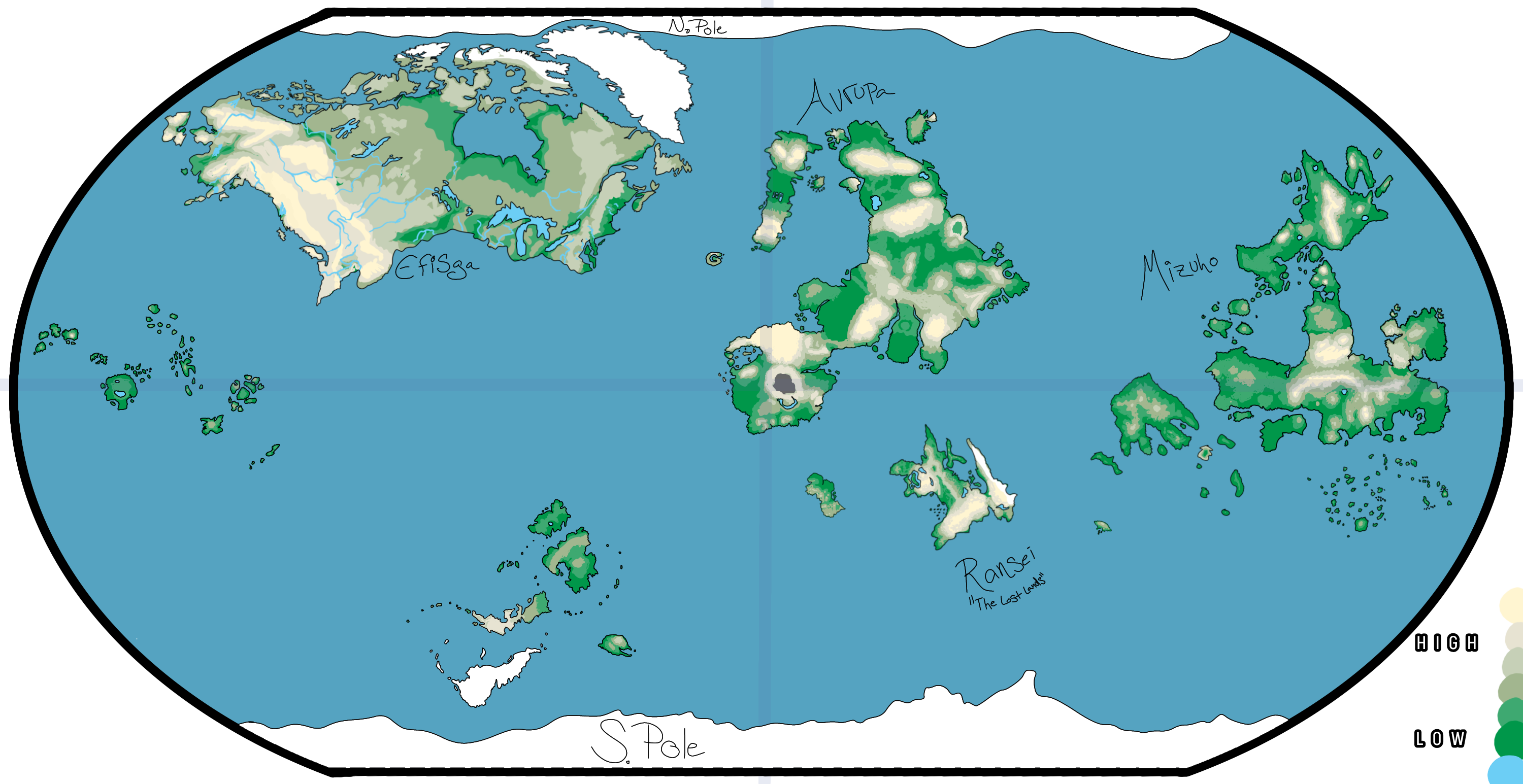
Efisga, Avrupa, Mizuho, and Ransei, with the Ransei continent being shrouded in mystery in modern times.
(Click to expand each section)
↓ Planetary Info ↓
Solar System:
Aureus orbits around a G-type Main Sequence Star as the 3rd planet from its host star, with 2 moons orbiting it. The star system overall consists of 6 total planetary bodies, with 3 rocky bodies in the inner system, 2 gas giants, and 1 ice giant in the outer system, with hundreds of moons orbiting the gas and ice giants. The largest of the gas giants is 5th in orbit, looming ominously beyond the frost line, acting simultaneously as protector and threat.
Aureus is recorded to be roughly 4.5 billion years old, with the host star being roughly 5 billion years old. It is the only planet in its star system that hosts life, although other moons possess thick atmospheres of their own, much like our own solar system. Aureus is roughly 75% the size of Earth.
The planet gets its name from one of the Latin words for “Gold”, “Aureus”, which sounds similar to Arceus and inspired by the golden ring on Arceus’ body.
Moons & Lunar Cycle:
Aureus boasts two moons; one of the moons appears much larger and brighter than its seemingly smaller sibling. These moons are called Cress’ea and Dak’ai, named for the Lunar Duo of Sinnoh, or Hisui in ancient times. These names can be found originating from ancient temples across the known world, leading researchers to believe that the names of the moons were the ancient peoples’ names for the Lunar Duo themselves. Both moons are commonly referred to as brother and sister, or simply the Siblings or Twins, with Cress’ea being the younger twin and Dak’ai being the older twin in ancient historical records.
Cress’ea is larger, controlling the majority of the tides across Aureus, with Dak’ai being not much smaller than the size of Pluto, having a minor effect on tides due to its distance. Cress’ea shines a bright, faint, pinkish-purple due to it having a thin atmosphere, while Dak’ai shines more of a medium grey like Uranus’ moon Umbriel. Both moons are tidally locked to Aureus.
The Lunar calendar is influenced by Cress’ea, which orbits Aureus roughly every 31.4 days, with the months being on average 32 or 33 days, with the ninth month being a total of 34 days, totalling to a 390-day year. Dak’ai orbits roughly every 99.6 days. The Aurean week consists of 8, 26-hour (roughly 59-60 Earth minutes) days, with a mandatory 1-2 hour break for rest across every Region, although this period and time of day it occurs varies between Region to Region, and even into the rural Sub-Regions within the Regions themselves.
The Moon cycle can be found here, and the Calendar names can be found here (presently empty).
The periods when Cress’ea and Dak’ai share full and new moons are considered auspicious due to how infrequently they occur. Double Brights are looked upon favourably, while Double Shadows are looked upon with caution. The most recent Double Bright occurred on 5th (7th Month), 2018, and the most recent Double Shadow occurred on 6th (2nd Month), 2017. Many False Doubles are witnessed yearly, where the siblings appear to be full, and instead are just barely out of phase with each other. Although rarely occurring, sometimes the doubles can have times where they're full or new for two days in a row. These are known, regardless of Shadows or Brights as “Blessed Doubles” and looked upon favourably, despite Double Shadows being looked upon with caution. Stories tell how the Twins gained an extra day of rest, work, or time with each other in these occurrences.
List of Double Bright & Shadows in descending order of most recent (W I P)
This main list will likely date back to Hisui, and then jump backwards to Ransei's timeline in another tableset.
| DOUBLE BRIGHT | |||||
|---|---|---|---|---|---|
| 5th, 7th Month, 2018 | 12th, 1st Month, 2008 | 2nd, 7th Month, 2006 | 20th, 12th Month, 2004 | 21st, 12th Month, 2004 | 9th, 6th Month, 2003 |
| 9th, 1st Month, 1996 | 31st, 6th Month, 1994 | Day, Month, Year | Day, Month, Year | Day, Month, Year | Day, Month, Year |
| Day, Month, Year | Day, Month, Year | Day, Month, Year | Day, Month, Year | Day, Month, Year | Day, Month, Year |
| Day, Month, Year | Day, Month, Year | Day, Month, Year | Day, Month, Year | Day, Month, Year | Day, Month, Year |
| Day, Month, Year | Day, Month, Year | Day, Month, Year | Day, Month, Year | Day, Month, Year | Day, Month, Year |
| Day, Month, Year | Day, Month, Year | Day, Month, Year | Day, Month, Year | Day, Month, Year | Day, Month, Year |
| Day, Month, Year | Day, Month, Year | Day, Month, Year | Day, Month, Year | Day, Month, Year | Day, Month, Year |
| Day, Month, Year | Day, Month, Year | Day, Month, Year | Day, Month, Year | Day, Month, Year | Day, Month, Year |
| Day, Month, Year | Day, Month, Year | Day, Month, Year | Day, Month, Year | Day, Month, Year | Day, Month, Year |
| Day, Month, Year | Day, Month, Year | Day, Month, Year | Day, Month, Year | Day, Month, Year | Day, Month, Year |
| Day, Month, Year | Day, Month, Year | Day, Month, Year | Day, Month, Year | Day, Month, Year | Day, Month, Year |
| Day, Month, Year | Day, Month, Year | Day, Month, Year | Day, Month, Year | Day, Month, Year | Day, Month, Year |
| DOUBLE SHADOW | |||||
|---|---|---|---|---|---|
| 6th, 2nd Month, 2017 | 28th, 7th Month, 2015 | 13th, 1st Month, 2014 | 14th, 1st Month, 2014 | 4th, 7th Month, 2012 | 22nd, 12th Month, 2010 |
| 25th, 7th Month, 2003 | 32nd, 6th Month, 2000 | 19th, 12th Month, 1998 | 8th, 6th Month, 1997 | 26th, 11th Month, 1995 | 17th, 12th Month, 1992 |
| 18th, 12th Month, 1992 | Day, Month, Year | Day, Month, Year | Day, Month, Year | Day, Month, Year | Day, Month, Year |
| Day, Month, Year | Day, Month, Year | Day, Month, Year | Day, Month, Year | Day, Month, Year | Day, Month, Year |
| Day, Month, Year | Day, Month, Year | Day, Month, Year | Day, Month, Year | Day, Month, Year | Day, Month, Year |
| Day, Month, Year | Day, Month, Year | Day, Month, Year | Day, Month, Year | Day, Month, Year | Day, Month, Year |
| Day, Month, Year | Day, Month, Year | Day, Month, Year | Day, Month, Year | Day, Month, Year | Day, Month, Year |
| Day, Month, Year | Day, Month, Year | Day, Month, Year | Day, Month, Year | Day, Month, Year | Day, Month, Year |
| Day, Month, Year | Day, Month, Year | Day, Month, Year | Day, Month, Year | Day, Month, Year | Day, Month, Year |
| Day, Month, Year | Day, Month, Year | Day, Month, Year | Day, Month, Year | Day, Month, Year | Day, Month, Year |
| Day, Month, Year | Day, Month, Year | Day, Month, Year | Day, Month, Year | Day, Month, Year | Day, Month, Year |
| Day, Month, Year | Day, Month, Year | Day, Month, Year | Day, Month, Year | Day, Month, Year | Day, Month, Year |
Eclipses:
Solar Eclipses are only recorded for Cress'ea, due to its closeness to Aureus, as well as it being the only one large enough to cause a noticeable enough effect on the planet. Dak’ai, while able to be seen in a Lunar Eclipse, has not been shown to have much of an effect in any Solar Eclipses. Lunar & Solar Eclipses occur roughly the same amount of times as they would on Earth. (Word of Creator: List of Lunar & Solar Eclipses are a major WIP as they need to be adjusted from Earth dates. I will add some of them in the future in another entry linked from this page.)
Eclipse Effects:
Eclipses also affect Pokemon, in ways that scientists have yet to figure out or agree upon things.
During SOLAR Eclipses:
During LUNAR Eclipses:
During BOTH Eclipses:
(Possible Eclipse Form for Cherrim, or a special Cherrim evolution that's really rare and only occurs during a total eclipse. ← currently working on this idea, it's put here for record-keeping)
Seasons:
Aureus has 4 seasons, broken up into 3-month periods per season, with the winter season straddling the beginning and end of the year. Winters and Summers on Aureus can vary from harsh and deadly to mild, while Spring and Autumn seasons are milder and generally bearable to handle regardless of the phases. Many throughout history have called the Spring and Autumn months various iterations of the Blessed Trinities due to their milder temperatures.
Although uncommon, some Spring and Autumn seasons have been harsh, leading to less crop yield in those years due to harsh harvests or planting periods. As a result, every Aurean has food stored in case of these harsh seasons. These harsh Autumns and Springs have been known as Blighted Trinities. The most recent Blighted year was back in 1956, causing a crisis across all of Avrupa due to a grain shortage. Other areas were severely affected, but not to the degree the average Avrupali was.
It was thought in the past that depending on where the sibling moons are in their orbits is what affected seasonal swings, until researchers discovered that it was the axis of the planet and orbit that affected these things, and is what gave the Spring and Autumn seasons their nicknames.
↓ Major Continents ↓
EFISGA:
Efisga's 4 regions are united under one system, operating in harmony with each other. The names of the Efisgan regions, while distinct areas themselves, are primarily for specifying where one is from or living. Efisga remains the least populated of the major inhabited continents due to its mountainous western half and colder climates up north.
A minor area of Efisga known as Orsay can be found on the continent’s Southeastern coast. Efisga's northernmost islands help serve as research outposts for studying the ecology of the northern pole.
AVRUPA:
Avrupa’s regions are all culturally and linguistically distinct, and in the past, many conflicts have arisen from this before the modern era; many of which were due to a lack of a Common language. Though this present-day peace is tenuous at times. Avrupa is the most densely populated continent, with Kalos boasting the highest population worldwide and Unova coming in second.
Avrupa's Major Regions comprise Galar, Kalos, Unova, Orre, and Kelta. Minor areas include Dahara, Alamos, Guyana, Vale, and Ryme.
MIZUHO:
Mizuho is a continent split into 3 major landmasses with islands scattered around. It has been affectionately given the title of “the land of united islands” by some. Mizuho once went by the name of Yashima until roughly 300 years ago, during a time when the regions began opening trade with the rest of the world, not long after Hisui began to be known as Sinnoh. Mizuho is the second most populated continent, not far behind Avrupa, with Kanto being the most populated among the Regions.
Mizuho's Major Regions comprise Kanto, Johto, Hoenn, Sinnoh, Fiore, Almia, Oblivia, and Ferrum. Minor areas include Kitakami, the ruins of Sinjoh, Alto Mare, Faraway Island, and the independent Kingdom of Rota.
RANSEI:
Ransei is shrouded in mystery and mythology, birthing many modern myths of both Unova and the Regions of Mizuho. While there are settlements across the land, they are very sparsely populated, and most are research outposts along the coastal regions. This continent used to be heavily populated, but an event in the past occurred that changed this, causing many people to migrate to Mizuho and Avrupa, leaving a majority of the continent abandoned. Many people can trace their origins back to these lands.
Ransei has, in modern times, gained the title of “The Lost Lands” due to its difficulty to reach.
INDEPENDENT ISLANDS:
The Major Island Regions of Alola, ??? (Winds/Waves Region???), Holon, TCG, and Lental are independently run, although the islands tend to work together and have a robust trade system between each other. Of these islands, Alola is the most populated one.
Decolore boasts a distinct Kalosian population blended with many Alolan and Holonian influences to make it uniquely its own. Lental, while the majority of its population is Pokémon, serves as a valuable research outpost on each of its islands and provides passage to the southern pole, where many researchers study Pokémon found in both areas.
↓ Money ↓
History:
The inhabitants of Aureus all use a united currency known as the “Avro”, to ease conflicts in Avrupa roughly 400 - 500 years ago, as no one could agree on a shared currency. Kalos insisted on the Franc, Unova & Orre on the Dollar, Galar & Kelta on the Sterling, and Paldea on the Peso, which nearly led to a continent-wide fallout and denial of trades, which could have led to a potential global economic collapse.
In one part to placate the arguing Avrupali leaders, the leaders of Efisga and Mizuho both called a meeting after private talks, and offered a solution that shocked many, though thankfully met with universal approval:
A universal global currency, called the Avro, whose worth would take the averages of all existing currencies and use the rounded down calculation. The other part was that calling the currency the Mizu or Efis didn't roll off the tongues of others well, nor did they have suitable plural forms, as well as Mizu being an existing word in the Mizuhoan languages, translating to “water”.
Currency:
1 Avro is equivalent to 100 Japanese Yen, and the conversion rate in Real World currency is roughly 1 Australian Dollar to an estimated 100 Avro = 1 AUD. To further this uniting of currency, a collective agreement to use Mizuho’s Poké symbol was established:
The Avro comes in paper and coin forms. Coins come in the form of 2, 1, 0.5, 0.25, 0.1, 0.05, and 0.01 coins. Paper money is the most commonly carried currency and comes in the form of 1, 2, 5, 10, 10, 50, and 100 bank notes. These coins and paper currencies feature unique designs, varying from Region to Region
All children begin their journeys with 3k Avro, provided to them by their region’s Pokemon League, something which was globalized as a requirement. This is to provide children with money for extra supplies and Pokemon care items, so that they don’t have to worry about running out of these supplies.
Pokemon Centers will waive fees for trainers staying overnight to eat and rest, Pokemon treatment is covered for all trainers for FREE. Non-trainers will generally have a small fee of 5 - 20 Avro for staying overnight in larger cities and towns; though they will often be recommended to a nearby hotel, so that young trainers can have a safe place to stay. Professional trainers will often stay overnight to help out, typically being referees or coaches to help trainers if they’re struggling.
↓ Ransei Changes ↓
In Morgan's timeline, Fusions of Pokémon do exist. The majority of these fusions exist in the long since abandoned and mysteriously difficult to reach region of Ransei. Ransei is surrounded by rough waters, making it difficult to traverse discreetly by sea, although over the years, this very thing has been done through the use of Legendaries under the control of a myriad of organisations, such as splinter factions of Team Rocket and Team Galactic, among others deemed too extremist. One such organisation has grown to call itself Cosmos. Its name origin is unknown, although many claim it's due to the name of the Cosmos Flower, others claim it's due to what these scientists did is so abhorrent that their crimes reach into the cosmos itself.
The crimes committed by this group are those of Fusion. Anything they could fuse, whether they should or not, they did. Genetic manipulation would also occur to create terrifying beasts, nearly wiping out some research labs. To call some of these individuals "depraved" would not be too far off from the truth. Many of these fusions have been left abandoned, due to either being too powerful or deemed "useless" by their creators and left in a state of suffering or pain. Some lucky few have made a niche on these islands, being able to adapt and survive, with a small percentage becoming dangerous predators.
Morgan, unfortunately, experiences a run-in with one such dangerous predator that achieved apex status; escaping due to pure luck from sources intervening to save her life that she could not have predicted. She will also encounter things beyond her depth, leading her to have a run-in with the Mythical Mew, forming a Bond with it, changing the course of her fate and life. As well as running into two famous individuals long thought dead in the past, but became Fallers into modern day.
(as a note: I'll only be using official pokemon in these fusions, as fusing fakemon would require more permissions and is more difficult to do when there are already existing fusion sites out there to use the sprites for. The majority of information about these things will be in Morgan's journal here as her timeline and events tackle Cosmos, although I'll be creating a journal entry with Cosmos' information at a much later date.)
↓ Reference of Regional Residents ↓
Mainline Regions:
Kanto: Kantonian
Johto: Johtonian
Hoenn: Hoennian
Sinnoh/Hisui: Sinnohan/Hisuian
Unova: Unovan
Kalos: Kalosian
Alola: Alolan
Galar: Galarian
Paldea: Paldean
Winds/Waves: TBA
Generation 10 will be the final region incorporated into this AU. Side & Legend games are subject to be added at my discretion. New Pokémon after the final region added will be included in other existing places in the world, places such as Guyana, Ranger regions, Holon, and other minor areas to give them distinct regional identity in their Pokémon. Some may be delegated to Efisga's lands as well.
Side Regions, Anime Included:
Holon: Holonian/Holonish (both used in-universe)
Almia: Almian
Orre: Orren
Oblivia: Oblivian
Fiore: Fioren
Lental: Lentalian/Lentan (both used in-universe)
Ferrum: Ferrish
Kitakami: Kitakamin. If this is ever officially updated, I will change it.
Sevii & Orange Islands are being grouped up into the Kanto Region, and Decolore Islands are being grouped up into Kalos as territories. These areas will be given their own PokéDexes to include future Pokémon as well as Fakémon
Minor, Anime Exclusive Regional Areas:
Dahara: Daharan
Rota: Rotan
Ryme: Rymish
Guyana: Guyanese
Vale: Valish
These small areas are minor Regions that lack a major gym circuit, and often will go to a Major Region for any gym challenges. While they lack a major gym circuit, they do possess minor circuits where some minor leaders can be scouted for Major Regions’ gyms.
An area like Alto Mare is part of Johto, and thus will not receive any. Likewise with Orsay, as it's a part of the wider Efisgan area. They are also considered to be Johtoan and Efisgan, respectively.
These areas have their own Starter Pokėmon as well to choose from, as well as their surrounding Major Regions’ Starter options, although not as commonly found or offered unless in the bigger cities of these Regions. Most trainers will be given one of the minor Region’s Starters or begin their journeys with something a sibling or parent caught for them. Orsay and Alto Mare often opt for Efisga’s (or Klondi’s) or Johto’s standard Starter options.
Unofficial Regions, Fan Included:
Klondi (Fan Region): Klondian
Kelta (Fan Region): Keltan
Efisga (Fan Continent): Efisgan (Information can be found through UsagiSquared on plurk)
Avrupa (The Continent): Avrupali
Mizuho (The Continent): Mizuhoan
Avrupa’s name comes from the real-world language of Turkish’s word for Europe, Avrupa. Avrupali comes from the same language’s word for Europeans.
↓ Flora, Fauna, Climate ↓
Flora:
The largest, most important part of keeping all life on Aureus stable. Plant life spans across all corners of the planet, underwater and on land alike. All life uses these plants in a variety of ways, from food to tools to various textiles, and even for their homes.
A key difference from Earth is that plant life is treated with more reverence and respect, often working alongside instead of against nature, for fear of Pokémon of any kind rampaging and destroying settlements. Especially settlements without as many protections as a larger city or Gym-controlled area in Regions with Gym circuits.
Berries that often aid Pokémon in battles are part of a unique botanical family that evolved alongside Pokémon themselves, and are all related to one another, evidenced in mutations that can occur when they're planted near one another. These berries were originally classified as being related to plants that have no effect on Pokémon, but studies in the field of these berries have shown no relatives or abilities to cross-breed with one another. Although there's no secondary effects on humans, this family of plants is edible and even commonly used in many dishes around the world just as often as other fruits or vegetables, often enhancing with their unique flavours and effects on the food itself. Documented human use showed a rise after a severe global famine, as one quality of these berries is their hardiness to survive through the harshest of conditions.
Fauna:
Aurean life is full of diverse animal life, ranging from Humans to anything under the sun, across all areas of the planet, settled into their own niches.
Next to Humans, Pokémon dominate the planet as the largest animal population on Aureus, possessing a wide array of abilities and forms, ranging from weak to god-like in power. Pokémon are the most adaptable creatures, finding ways to co-exist in most areas they're non-native to, with very few categorised as truly invasive species. Corphish is one such example of a true invasive species, originating from Efisga and introduced to places like Hoenn.
Mirroring the anime, Pokémon can appear anywhere their habitats could feasibly sustain them. A Swoobat could be found in Kantonian caves alongside a Zubat, with the inverse being true as well, although these individuals would be less common to find where they don't naturally occur in the games. This extends to Regional Variants, though there’ll typically be differences in their appearances. Kantonian Vulpix may be found on Wela Volcano, but it has a higher chance of possessing its native Alolan variant’s curlier fur while keeping its fire typing. The inverse is true on Mount Silver with a sleeker furred ice-type Alolan Vulpix.
Exceptions to this are places like Blueberry Academy's terrarium, as native Pokémon are imported for students to study.
Although they're uncommon to find, non-Pokémon animals have evolved to co-exist alongside their far larger counterparts. These animals are primarily used as food sources when out camping or in the wilderness without having to expend efforts to take down much more powerful Pokémon for food, or used as fodder for bait out in the open oceans in fishing boats. The majority of these small animals are fish that can be found in rivers or insects that typically flock to Pokémon similar to their species, such as the insects surrounding a Vespiquen.
It is assumed by scientists that these non-Pokémon animals will eventually go fully extinct, as records have shown a steady, though slow, decline worldwide; including deep sea life. This extinction process isn't predicted for the near future, as populations are still steady and have non-conflicting niches. Other scientists believe that these animals are going through a slower evolutionary process into becoming Pokémon themselves as new Pokémon species are still being discovered.
Climate:
The climate of Aureus is varied, much like Earth, with any biomes one can think of. Some of these climates are found in areas you would not find on Earth, and that answer can be explained simply: Pokémon.
While many areas are shaped by how the planet developed over billions of years, it would be disingenuous to say that these colossal monsters haven't played a hand in environmental development; with the likes of powerful god-like Pokémon shaping the span of continents down to less powerful Pokémon affecting local areas drastically. Due to these creatures shaping the world they inhabit, areas such as hot, dry, sandy deserts can occur in colder tundras and vice versa. Cold caves filled with ice and even snow can occur in tropical areas at sea level, with one notable example being the frigid Shoal Cave in the tropical area of Hoenn.


CONTINENTAL INFORMATION (DETAILED)
Date: 11 Nov 2025 06:03 am (UTC)EFISGA
Date: 11 Nov 2025 07:18 am (UTC)Culture & Linguistics
Date: 13 Nov 2025 12:01 pm (UTC)Linguistically, Efisga's languages are diverse. Parallels of Earth languages the likes of English, Chinese, Japanese, Russian, and French can be found all over; with Russian, Chinese, and Japanese influence being found further west toward Klondi, with French and English stretching further toward the eastern half. One can find all of these languages across the region in smaller pockets where they're less common.
placeholder
Date: 22 Jan 2026 11:25 am (UTC)AVRUPA
Date: 11 Nov 2025 07:33 am (UTC)Culture & Linguistics
Date: 13 Nov 2025 12:01 pm (UTC)Parallels of Earth languages the likes of English, French, Spanish, German, Irish, Norwegian, Finnish, Basque, and even Japanese can be found spoken throughout Avrupa. A tiny pocket of Avrupa, the minor region of Dahara, can be found speaking Arabic. The Avrupali Common languages all children learn along with their Regional mother tongue are Galarian (English) and Kalosian (French) due to these two being globally recognized for trade. Avrupali Common has also morphed into a blend of French & English together with dialects of one's home Region, and has been considered in recent years to be officialized as its own language.
placeholder
Date: 22 Jan 2026 11:25 am (UTC)MIZUHO
Date: 11 Nov 2025 09:11 am (UTC)Culture & Linguistics
Date: 13 Nov 2025 12:03 pm (UTC)Parallels of Earth languages the likes of Japanese, Chinese, Korean, Vietnamese, and Hindi among others can be found all over Mizuho. While the primary language used is Japanese, the others can be found in communities, although in smaller pockets with Japanese spoken alongside these. Mizuhoan Common is Japanese, and is taught across every corner of the continent, along with English for international trade and communication. French is encouraged although not mandatory, and is often only required if one is focusing on a profession where communication with Avrupa would be frequent on a more than a bi-monthly basis. Northeastern Sinnoh has a Russian speaking population due to geographic closeness to Efisga.
placeholder
Date: 22 Jan 2026 11:26 am (UTC)RANSEI
Date: 11 Nov 2025 09:13 am (UTC)Culture & Linguistics
Date: 13 Nov 2025 12:04 pm (UTC)Parallels of Earth languages the likes of (TBA) have been found in historical sites.
placeholder
Date: 22 Jan 2026 11:29 am (UTC)INDEPENDENT ISLANDS
Date: 11 Nov 2025 09:14 am (UTC)Culture & Linguistics
Date: 13 Nov 2025 12:05 pm (UTC)Parallels of Earth languages the likes of various Oceanic (namely Hawaiian), Indonesian, Malay, English, and French can be found all over these islands including the Lental Region as well as Westward into the Mizuhoan Sevii & Orange Islands. All children learn English and French alongside their native language(a) for ease of global trade. Decolore, while a Kalosian set of islands in this region, is a French majority speaking chain, although the Decolore dialect is heavily influenced by Holon and Alola's languages and culture making it the most linguistically drifted of any region with a set of islands.
placeholder
Date: 22 Jan 2026 11:29 am (UTC)A NOTE ON LANGUAGES
Date: 11 Nov 2025 04:57 pm (UTC)The languages I mention being spoken in the regions isn't ONLY that, but is the most common and what is officially recognized. Not every Earth language is a possibility, but it can be safely assumed that if a language is in the family of one mentioned, it could exist as a minor language or in the form of a dialect (IE: Swedish morphed into a Norwegian based dialect, Italian or Portuguese being morphed into a Spanish dialect) HOWEVER these would be much more uncommon if not rare or dying as a language/dialect over time or influences the main language.
All languages on Aureus aren't a 1:1 of the languages we speak on earth, but a close enough approximation to apply it as a parallel to our own with similar rules of conjugation, grammar, spelling, etc... One such example on language differences is in the "Russian" equivalent, where surnames are not gendered as they are here on Earth; there is no feminine form with "a" tacked on at the end, it'll be there for both sexes if that is a family surname. For example is the surname "Lebedev"/"Lebedeva", they would count as two separate surnames on Aureus while on Earth they would be the same with one denoting masculine and the other denoting feminine.
Written language in Aureus may appear different, like shown in the Anime, Manga, and Games. This written language is not one I have decided what it is, but it may be an approximation of English or French, which are used as common global languages both written and spoken all over. It is still a TBA at present.
World Map, with borders
Date: 1 Dec 2025 09:24 pm (UTC)